When we talk about science and agriculture, we must mention the soil food web. At a microscopic level, we learn that there are small organisms that provide life to the soil and in return to our plants. Beneficial bacteria, nematodes, insects, fungi… and the list go on.
In this article, we cover the soil food web, carbon sources, nutrients, and food in the soil. Also, the right time to water for healthy and better yielding plants, explain the biology and benefits of organic compost and much more.

What exactly is the soil food web
The easiest way to imagine the soil food web is to think of a complicated play with many different and interesting characters playing key roles in the play. The soil is the stage and all organisms, including plants, are the actors who play their part in the performance. The soil food web is a collective effort of beneficial bacteria, fungi, and micro-organisms that, under ideal conditions, provide an inexhaustible food bank for roots.
One of the most common and beneficial relationships that plants form is the symbiotic relationship with mycorrhizal fungi. The fungi physically attach themselves to the root hairs, or even penetrate the root’s cells, and become a helpful host. The aerobic bacteria in the soil help to speed up the decomposition of organic matter, which can then be transformed, and the digestible food returned to the roots.

The food source must be high in carbon, so compost, molasses, bone meal, fish emulsion and wood are all excellent sources. Providing carbon for the microbes and fungi will allow the soil food web to maintain its function and ensure that the microbial life force beneath the soil thrives.
How do plants interact with the food web?
Thanks to the highly efficient bacteria and fungi present in the soil, plants just need to use its roots to absorb nutrients and minerals. The way which plants interact with the soil food web is based on a long term relationship, and a survival mechanism against pathogens and anaerobic bacteria. One of the main benefits of using mycorrhizae and bacteria is to enhance the plant’s ability to endure drought periods without water. Plants which display a healthy soil food web relationship will often be more resilient and adaptive to certain stress levels than plants without.
The benefits of bacteria, organisms, and fungi
- Plant yields can be significantly increased with a well-balanced soil food web.
- Plants are visibly healthier and have better resilience to insects and climate.
- Beneficial bacteria and organisms will break down organic food for plants.
- Well-established beneficial bacteria and fungi work hard to fight off pathogens and disease.
- Root mass can be increased by using beneficial fungi.
- Biochar is an excellent source of carbon, able to last for centuries in the soil.
Carbon, nutrients, and food in the soil
Everything on the planet is a carbon life form, so it is no surprise that the microbes and fungi, which have co-existed on Earth for thousands of years, depend heavily on carbon as a food source. The easiest way to think about carbon, is to imagine how a piece of wood turns black, or a piece of coal has a specific colour, shine, structure, and texture. If you leave garden waste and leaves in a pile, over time the organic matter will break down, release its nutrients, and turn black and shiny. Molasses is a wonderful way to deliver high amounts of carbon back to the soil, and also, they improve the taste and aromas of your crop!

Improve plant and crop health using organic compost
Starting a compost pile at home is something that is cheap and easy to do. Simply using lawn clipping, leaves, twigs, and wood bark, creating a generous sized organic pile that will become inoculated with probiotic bacteria is simple to do. Not only will the black and brown, carbon and nutrient rich compost be an excellent additive to your garden, or as a top dress, it will also improve plant vitality, flower production and resilience levels.
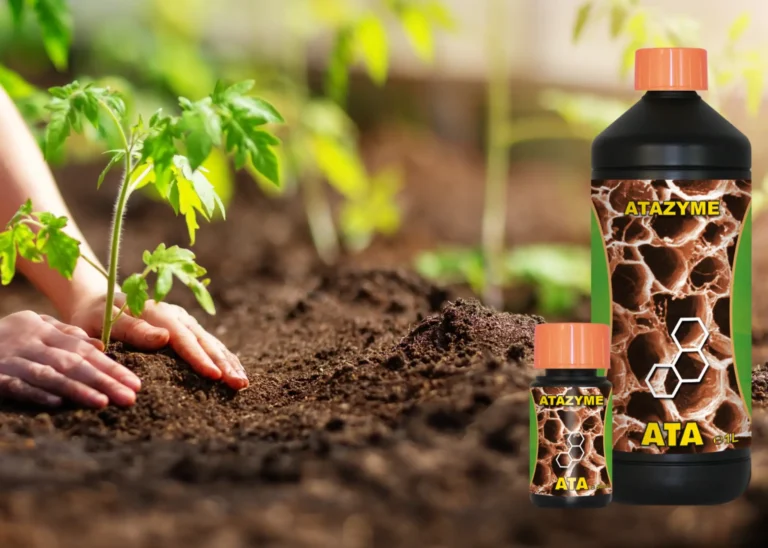
If you don’t want to make your own compost, using organic fertilisers and soil improvers will have a similar effect. If you want to bring your soil back to life, while enriching it, don’t miss this trio: ATAzyme, Upgrade y Worm Delight.
Atami’s conclusion
Once you learn about how tiny, microscopic organisms are responsible for providing so much life and nutrients for plants, you will become better after every grow. Soil biology is fascinating to say the least, and the way that the soil food web ensures there is always a constant supply of available nutrients for a plant, shows how Mother Nature keeps everything well-balanced. Adding organic inputs and amendments, keeping on top of available carbon and using compost will significantly increase the longevity, life force and quality of your soil.