It is that time of year when the days are shorter, the temperature is coldest, and most growers spend more time in their indoor grow rooms. If you are a first-time grower, then you are asking yourself How do you grow cannabis indoors and What grow lights do you need to grow cannabis indoors? You may also be curious about growing cannabis in the winter, and wondering if you can grow cannabis in a greenhouse in the winter.
Well, in this article, I will cover everything you need to know about indoor cannabis growing and the importance of lighting for your indoor cannabis grow. Covering the importance of PAR, PPFD, humidity levels and the different light cycles necessary. In addition to growing cannabis in a greenhouse during the winter, consider the following and follow my top tips to help you produce the best possible crops both indoors and outdoors this winter.
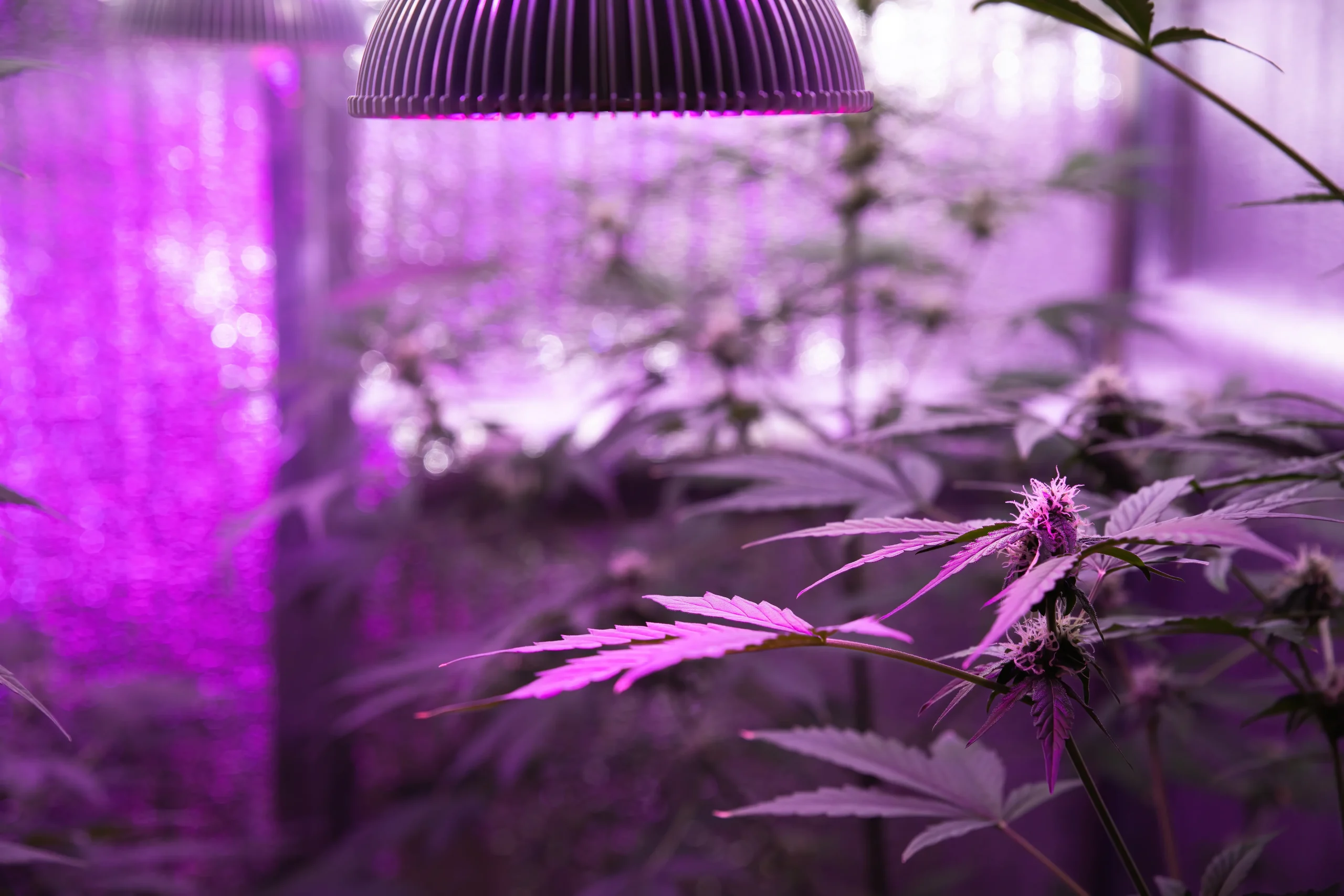
How to Grow Cannabis Indoors Using Grow Lights
When growing cannabis plants outdoors, you are reliant on the seasons and only have so much control over how much sunlight your plant receives. When it comes to indoor cannabis growing, not only do you get to control the temperature and humidity, but also light intensity and the number of hours the plants receive light or darkness.
To become a great indoor grower, ensuring you have the correct grow light for cultivation is crucial. Below is a breakdown of all the different grow lights available for use.
Compact Fluorescent Lights
CFL grow lights for indoor cannabis cultivation provide a low-powered solution; however, they do not contain the relevant intensity needed to produce large yields. CFL lights can be purchased with either a blue spectrum (6400 K) for the vegetation stage or a red light spectrum (2700 K) for the flowering period.
- Compact fluorescents are ideal for the seedling and vegetation stage
- They do not use much power, typically ranging between 125W and 250W
- CFL lights for flowering will not produce large yields
- T5 strip lights are efficient for small spaces and for rooting clones
LED Grow Lights
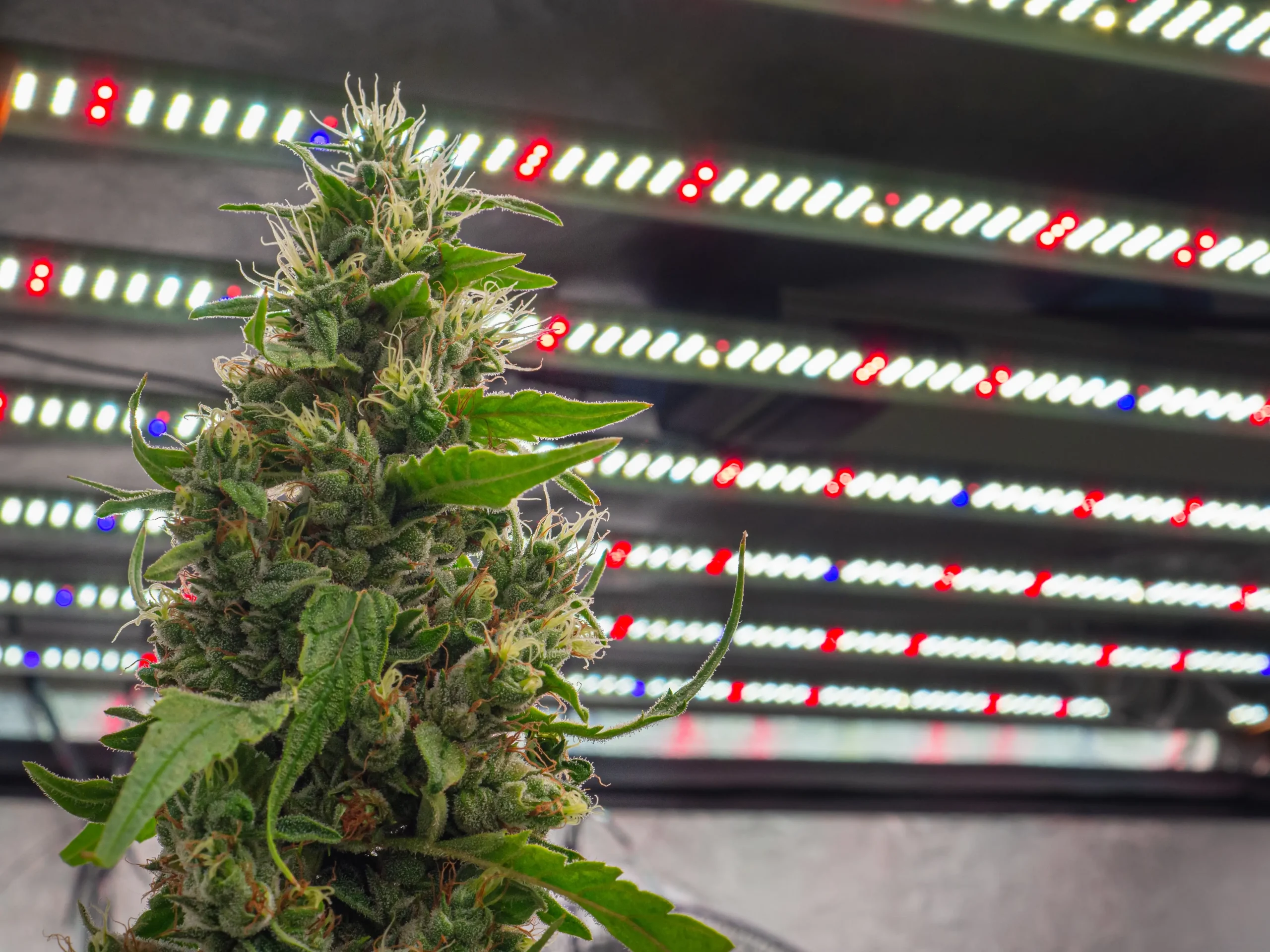
It is fair to say that LED grow lights are the most sought-after lights for indoor cannabis growing. LED lights produce minimal amounts of heat, are highly efficient in electricity use, are manufactured with a dimming device, and provide the optimal light spectrum from seed to harvest.
- LED lights produce all of the light wavelengths that cannabis plants need
- They do not give off much heat compared to MH or HPS lights
- Most companies produce dimmable lights for optimal light control
- LEDs provide cannabis plants with high levels of photosynthetically active radiation
- LED lights are capable of producing top-quality flowers for an indoor cannabis grow
Metal Halide Lights
Metal halide grow lights have been used for indoor cannabis growing for decades. They are essentially the same lights used to illuminate car parks or sports stadiums, producing a balanced white light. A ballast and reflector are required when using metal halide lights, as they can create a significant amount of heat.
- Metal halide lights produce a spectrum that is ideal for the vegetative stage
- They are available in 400w, 600w and 1000w for indoor cultivation
- They should be supplemented with an HPS light when flowering cannabis indoors
- These lights can take longer to heat up or cool down compared to LED lights
High-Pressure Sodium Lights
HPS grow lights were the most popular indoor cannabis grow lights before LED entered the scene. High-pressure sodium lights are similar to MH lights, as they also require a ballast and reflector to work. Many old-school growers pair HPS and MH lights together during flower production, as they can achieve a full spectrum and provide optimal PAR levels.
- HPS lights should be used for the flowering period due to their spectrum
- They are available in 400w, 600w and 1000w for indoor cultivation
- Their spectrum is yellow 570-590 (nm), orange 590-630 (nm) and red 630-750 (nm)
- The colour of light appears yellow compared to the white MH and the LED produced
How Do You Grow Cannabis Indoors - The Different Light Cycles
The lifecycle of a cannabis plant involves the seedling, vegetation and flowering stage. During the different stages, your plants will require different darkness periods, as well as temperature and humidity levels.
The Seedling Stage – 18/6
From the day you germinate your seeds, until 2-3 weeks later, you will undergo the seedling stage. During this time, your seeds will focus on producing roots and their first set of true leaves. The grow light will need to be on for 18 hours a day with 6 hours of dark, to replicate the summer season.
- CFL, MH and LED are ideal for the seedling stage; however, they should be low intensity
- Cannabis seedlings require a blue-dominant light spectrum during the first 2-3 weeks
- Humidity levels should be between 65% and 70% during the seedling stage
The Vegetative Stage – 18/6
Once your plants have passed the seedling stage, they will be ready for more intense lighting. It is during this stage that cannabis plants focus their energy on producing roots, the stem, leaves and side branches. Your grow light will remain on for 18 hours a day, with a 6-hour darkness period.
- Cannabis plants can be kept in a vegetative period for up to 12-16 weeks indoors
- Most indoor cannabis grow rooms vegetate their crops for 3-6 weeks before flowering
- The humidity levels should remain high and as close to 70% during vegetation
The Flowering Stage – 12/12
After your plants have grown into a good size during vegetation, they can be flowered. This is when your plants will begin to stretch, significantly increase in size, and produce pre-flowers, which will later develop into cannabis buds. For an indoor cannabis grow, plants need to be exposed to 12 hours of light and 12 hours of darkness and exposed to more red and far red llight.
- The flowering period typically ranges from 7 to 12 weeks, depending on the genetics
- High-pressure sodium and LED are the most suitable lights for the flowering stage
- The humidity levels during 12/12 should be between 40% and 50% to prevent mould
Indoor Cannabis Growing, PAR and PPFD Explained
When a cannabis plant performs photosynthesis, it converts light energy known as photons. PAR is an acronym for photosynthetically active radiation, which ranges from 400 to 700 nanometers. Indoor cannabis grow lights are capable of producing different light spectrums that are within the PAR spectrum.
PPFD refers to photosynthetic photon flux density and is a term used to describe the amount of photosynthetically active photons that a cannabis plant receives per second, while the lights are switched on.
PPFD is measured in micromoles per square meter per second and is a measurement provided by lighting manufacturers to explain the efficiency of their light. Below is a table showing the recommended PPFD levels for each stage of a plant’s lifecycle, applicable to both photoperiod and autoflowering cannabis plants.
| Life Cycle Stages – Photoperiod | PPFD |
| Seedlings | 100 – 300 (µmol/m2/s) |
| Vegetative | 400 – 600 (µmol/m2/s) |
| Flowering | 600 – 1000 (µmol/m2/s) |
| Life Cycle Stages – Autoflowering | PPFD |
| Seedlings | 200 – 300 (µmol/m2/s) |
| Vegetative (4 Weeks) | 400 – 600 (µmol/m2/s) |
| Flowering | 600 – 900 (µmol/m2/s) |
Autoseeds advises that if you’re using LED lights, they can be placed closer to the plants. In contrast, HPS lights need to be positioned a bit further away due to the heat they generate. Keep adjusting the height of your lights to maintain your PPFD within the optimal range for each growth stage, using a light meter.
Growing Cannabis in the Winter Indoors - What to Consider
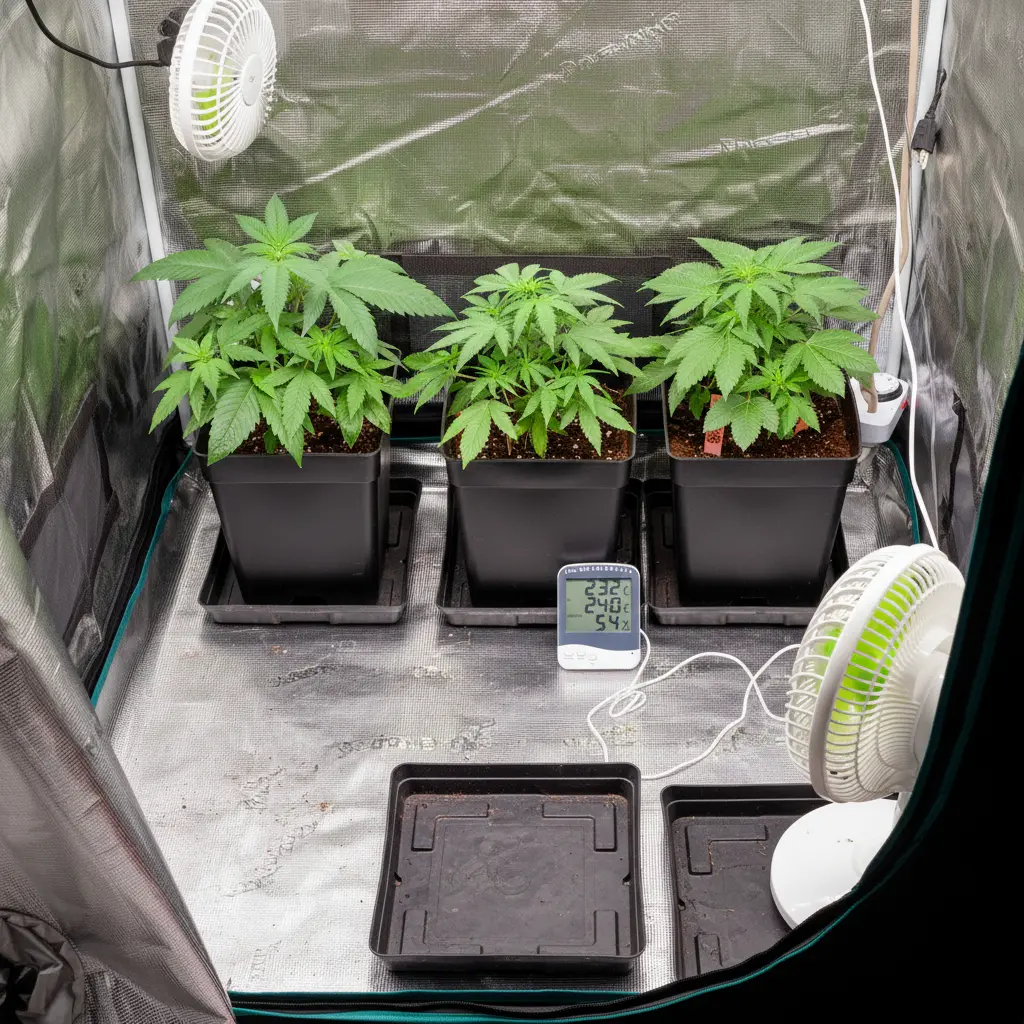
During the winter season, it can be challenging to keep your grow room warm and cosy. Especially if you are pulling cold air in from outside using an extractor or an inline fan. Whilst it may be the hardest time of the year to keep the grow room environment optimal, below are a few factors to consider to help make life easy when growing cannabis in the winter.
Heating Cables
You can purchase heating cables online, which are available in sizes ranging from 1m to 50m. They are a low-powered solution to keeping the grow room floor or seedling/cloning room consistently warm, without raising the electric bill.
Small Heaters
Adding a small heater to your grow room can help warm up the air. Gas heaters do not use any electricity and can quickly heat up an ample grow space, without the concern of causing power outages.
Digital Hygrometers
The best way to monitor the daytime and nighttime temperature when doing an indoor cannabis grow is to use a digital hygrometer. Most devices have a setting that allows you to see the difference between the lowest and highest temperatures. This will be a clear indication if your growing environment is too cold or humid and if you need to adjust the temperature and humidity.
Temperature Fan Controllers
Although they may seem expensive to purchase, temperature fan controllers are ideal for growing cannabis in winter. They can be programmed and connected to a small heater, which will turn on and off when the temperature you have programmed is out of range.
Check for Mould and Mildew
Mould and mildew are pathogens that can attack your plants when the airflow is inadequate, combined with high humidity levels and low temperatures. During the flowering stage, check daily for signs of mould and powdery mildew.
Fabric Pots
Plastic pots may be cheap to buy, but fabric pots are a fantastic way to help raise the temperature of the root zone during your indoor grow. The reason is that the air around the pots will insulate the roots and help keep them warm, especially if you are using a heating cable on the floor.
Can You Grow Cannabis in a Greenhouse in the Winter?
The only way that you can grow cannabis in a greenhouse in winter is to use femenzied autoflowering cannabis seeds. You will only be able to grow small-sized plants, which may vary in size between 30 and 60cm. The yield may also be low due to the limited sun exposure and cold nighttime temperatures. You could always add a heater inside the greenhouse to help maintain a consistent temperature between 18 and 20 degrees Celsius.